|
lucid
0.0.3
Lifting-based Uncertain Control Invariant Dynamics
|
|
|
lucid
0.0.3
Lifting-based Uncertain Control Invariant Dynamics
|
During cross-validation, the available data is split into k folds. More...
#include <CrossValidator.h>
Public Types | |
| using | SliceSelector = std::vector<std::vector<Index>> |
| Type alias for slice selector. | |
Public Member Functions | |
| double | fit (Estimator &estimator, ConstMatrixRef training_inputs, ConstMatrixRef training_outputs, const scorer::Scorer &scorer=nullptr) const |
| Fit the estimator using cross-validation on the provided training_inputs and training_outputs. | |
| double | fit (Estimator &estimator, ConstMatrixRef training_inputs, ConstMatrixRef training_outputs, const Tuner &tuner, const scorer::Scorer &scorer=nullptr) const |
| Fit the estimator using cross-validation on the provided training_inputs and training_outputs using the tuner tuner to optimize @hp. | |
| std::vector< double > | score (const Estimator &estimator, ConstMatrixRef inputs, ConstMatrixRef outputs, const scorer::Scorer &scorer=nullptr) const |
| Evaluate the estimator using cross-validation on the provided inputs and outputs. | |
| virtual Dimension | num_folds (ConstMatrixRef training_inputs) const =0 |
| Get the number of folds used in the cross-validation on the provided training_inputs. | |
| virtual std::string | to_string () const |
| Obtain the string representation of this object. | |
Protected Member Functions | |
| double | fit (Estimator &estimator, ConstMatrixRef training_inputs, ConstMatrixRef training_outputs, const Tuner *tuner, const scorer::Scorer &scorer) const |
| Fit the estimator using cross-validation on the provided training_inputs and training_outputs using the tuner tuner to optimize @hp, if provided. | |
| virtual std::pair< SliceSelector, SliceSelector > | compute_folds (ConstMatrixRef training_inputs) const =0 |
| Compute the training and validation folds for cross-validation. | |
During cross-validation, the available data is split into k folds.
The model is trained k times, each time using k-1 folds for training and the remaining fold for validation. The final model is the one that achieved the best validation score across all folds. This technique helps to mitigate overfitting and provides a more robust estimate of the model's performance.
|
nodiscardprotectedpure virtual |
Compute the training and validation folds for cross-validation.
Each fold is represented as a pair of index vectors, where the first vector contains the indices for the training set and the second vector contains the indices for the validation set.
| training_inputs | \( \texttip{n}{Number of samples} \times \texttip{d_x}{Dimension of the input vector space} \) training input data |
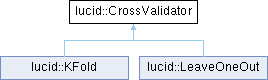
Implemented in lucid::KFold, and lucid::LeaveOneOut.
| double lucid::CrossValidator::fit | ( | Estimator & | estimator, |
| ConstMatrixRef | training_inputs, | ||
| ConstMatrixRef | training_outputs, | ||
| const scorer::Scorer & | scorer = nullptr ) const |
Fit the estimator using cross-validation on the provided training_inputs and training_outputs.
The scorer is used to evaluate the performance of the model on the validation folds. If no scorer is provided, the estimator's default scoring method is used. At the end, the estimator is updated to the best model found during cross-validation.
| [in,out] | estimator | estimator to fit. It will be updated to the best model found |
| training_inputs | \( \texttip{n}{Number of samples} \times \texttip{d_x}{Dimension of the input vector space} \) training input data | |
| training_outputs | \( \texttip{n}{Number of samples} \times \texttip{d_y}{Dimension of the output vector space} \) training output data | |
| scorer | scoring function to evaluate the model's performance |
| double lucid::CrossValidator::fit | ( | Estimator & | estimator, |
| ConstMatrixRef | training_inputs, | ||
| ConstMatrixRef | training_outputs, | ||
| const Tuner & | tuner, | ||
| const scorer::Scorer & | scorer = nullptr ) const |
Fit the estimator using cross-validation on the provided training_inputs and training_outputs using the tuner tuner to optimize @hp.
The scorer is used to evaluate the performance of the model on the validation folds. If no scorer is provided, the estimator's default scoring method is used. At the end, the estimator is updated to the best model found during cross-validation.
| [in,out] | estimator | estimator to fit. It will be updated to the best model found |
| training_inputs | \( \texttip{n}{Number of samples} \times \texttip{d_x}{Dimension of the input vector space} \) training input data | |
| training_outputs | \( \texttip{n}{Number of samples} \times \texttip{d_y}{Dimension of the output vector space} \) training output data | |
| tuner | tuner to optimize @hp | |
| scorer | scoring function to evaluate the model's performance |
|
protected |
Fit the estimator using cross-validation on the provided training_inputs and training_outputs using the tuner tuner to optimize @hp, if provided.
The scorer is used to evaluate the performance of the model on the validation folds. If no scorer is provided, the estimator's default scoring method is used. At the end, the estimator is updated to the best model found during cross-validation.
| [in,out] | estimator | estimator to fit. It will be updated to the best model found |
| training_inputs | \( \texttip{n}{Number of samples} \times \texttip{d_x}{Dimension of the input vector space} \) training input data | |
| training_outputs | \( \texttip{n}{Number of samples} \times \texttip{d_y}{Dimension of the output vector space} \) training output data | |
| scorer | scoring function to evaluate the model's performance |
|
nodiscardpure virtual |
Get the number of folds used in the cross-validation on the provided training_inputs.
This is determined by the specific cross-validation strategy implemented in the derived class.
| training_inputs | \( \texttip{n}{Number of samples} \times \texttip{d_x}{Dimension of the input vector space} \) training input data |
Implemented in lucid::KFold, and lucid::LeaveOneOut.
|
nodiscard |
Evaluate the estimator using cross-validation on the provided inputs and outputs.
No fitting or tuning is performed, hence the estimator will only be consolidated on each fold, but no @hp will be optimized. The scorer is used to evaluate the performance of the model on each fold. If no scorer is provided, the estimator's default scoring method is used. The result is a vector of scores, one for each fold.
| estimator | estimator to evaluate |
| inputs | \( \texttip{n}{Number of samples} \times \texttip{d_x}{Dimension of the input vector space} \) input data |
| outputs | \( \texttip{n}{Number of samples} \times \texttip{d_y}{Dimension of the output vector space} \) output data |
| scorer | scoring function to evaluate the model's performance |
|
nodiscardvirtual |
Obtain the string representation of this object.
Reimplemented in lucid::KFold, and lucid::LeaveOneOut.
 1.15.0