Learning-Enabled Uncertainty-Aware Certification of Stochastic Dynamical Systems




E. Casablanca
O. Schön
P. Zuliani
S. Soudjani





Motivation
- Reality is not ideal
- Noisy sensors
- External agents
- Unknown/Complex dynamics
- Can we trust AI?

Stochastic dynamical systems
How to learn a safety certificate for a system with unknown stochastic dynamics?
Loading diagram...
Loading diagram...
Loading diagram...
Loading diagram...
Unknown: we don’t know the model
Unknown + Noisy: we don’t know the model & there is random noise
Stochastic dynamical systems
We are interfacing with
- state space ,
- control input space ,
- a probability measure over ,
- a transition function .
From the current state and control input , the next state is obtained as
Goal
The goal is to find a lower bound on the probability that the system satisfies some specification (safety) over a time horizon .
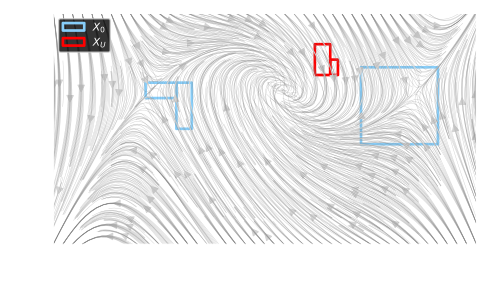
Barrier certificates
Barrier certificates leverage set invariance to provide safety guarantees.
Barrier certificates
Given a state space , initial set and unsafe set ,
a barrier certificate is a function
and constants , such that
Barrier certificates
For any valid barrier and time horizon , the safety probability is lower bounded by
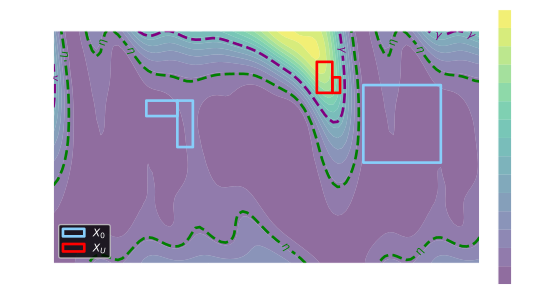
Data-driven Barrier Certificates
- Data-driven approach
- Does not require knowledge of
- Learns by sampling 1-step transitions times
- Barrier constraints enforced via Conditional Mean Embeddings
Loading diagram...
[3] J. Park, K. Muandet (2020) A Measure-Theoretic Approach to Kernel Conditional Mean Embeddings
Spectral abstraction
- is infinite-dimensional
- Gaussian kernel truncated Fourier series expansion (feature map)
- Constraint relaxation via trigonometric bounds on lattices
- Can be used in an linear optimization
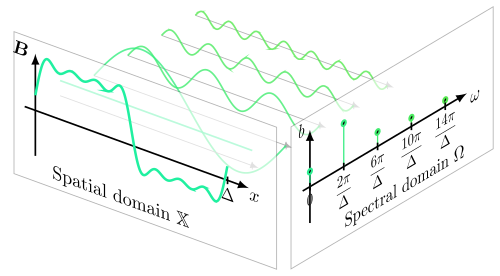
[4] O. Schön, Z. Zhong, S. Soudjani (2025) Kernel-Based Learning of Safety Barriers
Lucid
Learning-Enabled Uncertainty-Aware Certification of Stochastic Dynamical Systems
- C++ for performance and control
- Python3 interface for usability
- Modular and extensible
- Python package (
pylucid) - Docker image (
ghcr.io/tendto/lucid) - Live demo on the browser

Features
| Tool | Guarantees | Data Driven | Stochastic Dyn. | Non-poly Dyn. | Stat. correct. |
|---|---|---|---|---|---|
| LUCID | ✓ | ✓ | ✓ | ✓ | ✓ |
| TRUST (2025) | ✓ | ✓ | ✗ | ✗ | ✓ |
| FOSSIL (2024) | ✓ | ✗ | ✗ | ✓ | NA |
| OMNISAFE (2024) | ✗ | ✓ | ✓ | ✓ | ✗ |
| NPINTERVAL (2023) | ✓ | ✗ | ✓/✗ | ✓ | NA |
Main components

Execution flow

Architecture
Loading diagram...
Example
Define the system and sample some points.
N = 1000
# Transition function f
f = lambda x: ...

# State space
X_bounds = RectSet((-3, -2), (2.5, 1))
# Initial set
X_i = MultiSet(
    RectSet((1, -0.5), (2, 0.5)),
    RectSet((-1.8, -0.1), (-1.2, 0.1)),
    RectSet((-1.4, -0.5), (-1.2, 0.1)),
)
# Unsafe set
X_u = MultiSet(
    RectSet((0.4, 0.1), (0.6, 0.5)),
    RectSet((0.4, 0.1), (0.8, 0.3))
)

x_samples = X_bounds.sample(N)
# We simulate the next state samples by applying f
xp_samples = f(x_samples)
Loading diagram...
Example
Train the estimator to predict the feature map.
# Create a truncated Fourier feature map
feature_map = LinearTruncatedFourierFeatureMap(
    num_frequencies=7, # Include the 0th frequency
    sigma_f=1.0,
    sigma_l=[0.05, 0.15],
    X_bounds=X_bounds,
)

# Apply the feature map to the samples
xp_features = feature_map(xp_samples)

# Train the estimator
estimator = KernelRidgeRegressor(
    kernel=GaussianKernel(sigma_l=[0.320, 0.157],
                          sigma_f=1.0),
    regularization_constant=1e-8,
)
estimator.fit(x_samples, xp_features)
Loading diagram...
Example
Synthesize the barrier certificate.
# Synthesize the barrier certificate
b = FourierBarrierCertificate(T=5, gamma=1.0)
success = b.synthesize(
    X_bounds=X_bounds,
    X_init=X_init,
    X_unsafe=X_unsafe,
    estimator=estimator,
    feature_map=feature_map,
    lattice_resolution=330,
    parameters=FourierBarrierCertificateParameters(
        set_scaling=0.025,
    ),
)

# [info] Computing LP coefficients
# [info] Optimizing
# [info] Solution found
# [info] Safety probability is 68.08%
Loading diagram...
Live demo
Future work
- Tackle Non-Linear optimization directly.
- Temporal logic specifications, not just safety.
- Support more kernels, feature maps and estimators.
- Extension to control synthesis.
- Improved hyperparameter tuning.
References
- A. Salamati, A. Lavaei, S. Soudjani, M. Zamani (2021) Data-Driven Safety Verification of Stochastic Systems via Barrier Certificates
- H. J. Kushner (1967) Stochastic Stability and Control
- J. Park, K. Muandet (2020) A Measure-Theoretic Approach to Kernel Conditional Mean Embeddings
- O. Schön, Z. Zhong, S. Soudjani (2025) Kernel-Based Learning of Safety Barriers
- LUCID GitHub Repository
- E. Casablanca, O. Schön, P. Zuliani, S. Soudjani (2026) LUCID: Learning-Enabled Uncertainty-Aware Certification of Stochastic Dynamical Systems
Thank you!
Barrier certificates
Given a state space , initial set and unsafe set ,
a barrier certificate is a function
and constants , such that
Conditional mean embeddings
LP formulation
Example
Define the system and sample some points.
N = 1000
# Transition function f
f = lambda x: ...

# State space
X_bounds = RectSet((-3, -2), (2.5, 1))
# Initial set
X_i = MultiSet(
    RectSet((1, -0.5), (2, 0.5)),
    RectSet((-1.8, -0.1), (-1.2, 0.1)),
    RectSet((-1.4, -0.5), (-1.2, 0.1)),
)
# Unsafe set
X_u = MultiSet(
    RectSet((0.4, 0.1), (0.6, 0.5)),
    RectSet((0.4, 0.1), (0.8, 0.3))
)

x_samples = X_bounds.sample(N)
# We simulate the next state samples by applying f
xp_samples = f(x_samples)
Loading diagram...
Example
Train the estimator to predict the feature map.
# Create a truncated Fourier feature map
feature_map = LinearTruncatedFourierFeatureMap(
    num_frequencies=7, # Include the 0th frequency
    sigma_f=1.0,
    sigma_l=[0.05, 0.15],
    X_bounds=X_bounds,
)

# Apply the feature map to the samples
xp_features = feature_map(xp_samples)

# Train the estimator
estimator = KernelRidgeRegressor(
    kernel=GaussianKernel(sigma_l=[0.320, 0.157],
                          sigma_f=1.0),
    regularization_constant=1e-8,
)
estimator.fit(x_samples, xp_features)
Loading diagram...
Example
Synthesize the barrier certificate.
# Synthesize the barrier certificate
b = FourierBarrierCertificate(T=5, gamma=1.0)
success = b.synthesize(
    X_bounds=X_bounds,
    X_init=X_init,
    X_unsafe=X_unsafe,
    estimator=estimator,
    feature_map=feature_map,
    lattice_resolution=330,
    parameters=FourierBarrierCertificateParameters(
        set_scaling=0.025,
    ),
)

# [info] Computing LP coefficients
# [info] Optimizing
# [info] Solution found
# [info] Safety probability is 68.08%
Loading diagram...